Wednesday, May 30, 2012

Daily lectionary: Being People After God's Own Heart

Morning Psalms 15, 147:1-11
Proverbs 17:1-20
1 Timothy 3:1-16
Matthew 12:43-50
Evening Psalms 48, 4


"His pleasure is not in the strength of
the horse,
nor His delight in the legs of a man;
the Lord delights in those who fear
Him,
who put their hope in His unfailing
love."

Psalm 147:10-11
God does not value the same things people value.

Let's be people after God's own heart; people who put our hope in His unfailing love!

We need to exercise the muscles of our hearts that hope in Him to hope more. One thing we can do for one another to help exercise those muscles is share with each other the things that make us hope more. For example, one of the things that makes me hope in God's love is the love I feel for my wife, my children (including my son-in-law) and my grandchildren. It's a love so intense I feel at times as if it may consume me! When I remember that the love I feel is a tiny spark in comparison to the conflagration of God's love for us, I hope more in His love.

What makes you hope in God's love?


Sunday, February 12, 2012

Seeing God's Face; St. Andrew's Church, Lisbon

Psalm 30
2 Kings 5:1-14
Mark 1:40-45
1 Corinthians 9:24-27

When you smile, the air grows warm and soft,
the earth is watered with gentle mists,
seeds sprout and spread leaves above the dark, damp soil,
earthworms pierce the crust and frolic across the surface
to the delight of fat, happily hunting robins,
lilies of the valley unfurl beside purple, grape-scented irises,
fat pink and maroon peonies, and gay California poppies,
damask roses hurl their rich fragrance to the wind,
the crazy-with-sheer-joy song of the Northern mockingbird
echoes above other chirps and sweet winged notes,
gardeners join the worms in the warm, rich dirt,
children gallop across yards and grab handfuls of dandelions
to present to mothers who will set them in glasses of water
in kitchen windows or on dining room tables, weeds
glorious after the dark of winter with the color of the sun
that grows and warms and heals in your smile.

That’s “The Sun Grows In Your Smile,” by Linda Rodriguez.

When you smile at someone it causes a reaction in the part of their brain that processes visual images, but it also causes a reaction in their soul. Children don’t really gallop across yards, but it’s as if they did. When you smile at me, my heart leaps!

I remember when my family first visited Portugal in the summer of 2000. We rented a little cottage in Colares. Shortly after we arrived I went for a walk. I was jet-lagged and disoriented and far from my comfort zone. Naturally, I got lost. I came to a narrow section of sidewalk and there on the other side was a little old Portuguese woman, dressed in black, with the skin that's turned to soft leather. I expect she was an angel. We looked at each other and realized we weren't going to get through this without some sort of extraordinary maneuver. We turned sideways and began moving carefully past each other and she looked at me and smiled. At the time I didn't understand Portuguese. Now I know that she was saying with her smile, "Conseguimos, filho." "We did it, lad." All I knew at the time was that the sky opened up and I felt my feet firmly on the ground and I was no longer lost. Something similar happens in our relationship with God.

As we’ve already seen this morning, Psalm 30 says,

“When I felt secure, I said,
            “I will never be shaken.”
O Lord, when You favored me,
            You made my mountain stand firm;”

That’s a good day. I have those. When I feel like Jesus and I are just like this [crossed fingers]. I’m bullet-proof.

“But when You hid Your face,
            I was dismayed.“
“mas se desvias de mim o Teu olhar, fico cheio de medo.” “I’m full of fear.”

That’s a bad day. I have those, too. To borrow another of David’s expressions, my heart turns to wax. I’m afraid of my own shadow. Like the guy described in Proverbs who says, “There’s a lion in the road, a fierce lion roaming the streets.” Everything looks like a lion.

In his excellent book, How to Improve Your Marriage Without Talking About It, Dr. Steven Stosny describes the way in which a woman’s body undergoes physiological and chemical changes in response to her husband when he turns his face from her in anger, gives her the cold shoulder. Dr Stosny says her reaction arises from a built in fear of abandonment. It´s automatic; not ordinarily under her control. I’m very much like that with God. If anything, whether of commission or omission, comes between me and the Holy Spirit, I’m just doo-doo.

This idea of seeing God’s face recurs often in scripture and it has been a primary theme in my own faith journey over the past several years. One of its more familiar appearances is that wonderful blessing from the 6th chapter of the Book of Numbers I like to use when quitting the company of my own children:

“The Lord bless you and keep you;
the Lord make His face to shine upon you
and be gracious to you;
the Lord turn His countenance towards you
and give you peace.”

The Hebrew word translated “peace” there is, of course, “shalom.” It’s a vast word you can never come to the end of.

Another familiar reference to seeing God’s face
is the one you hear at nearly every Christian wedding in the United States, from the Love Chapter, 1 Corinthians 13:

“Now we see but a poor reflection as in a mirror; then we shall see face to face. Now I know in part; then I shall know fully, even as I am fully known.”

From these two texts, Numbers 6 and 1 Corinthians  13, and others like them, it appears that we need to make a distinction between a certain apprehension of God’s face that is possible now and a different seeing of God’s face that is reserved for the future. God, in response to Moses’ request to be shown His glory, said,

“You cannot see my face, for no one may see me and live,” (Exodus 33:20),

but David, in one of the great orienting verses, one of the verses to set your GPS by, says in Psalm 27:

“One thing I ask of the Lord,
            this is what I seek:
that I may dwell in the house of the Lord
            all the days of my life,
to gaze upon the beauty of the Lord
            and to seek Him in His temple.”

In my Boas Novas Portuguese translation, that verse that’s translated, “to gaze upon the beauty of the Lord,” is translated  “para sentir a amizade do Senhor,” that is, “to sense the Lord’s friendship.” That really works for me. When I go about with an abiding sense of God’s friendship, that in all things, even in the difficulties, He works for the good of those who love Him, I’m golden. Unfortunately, I forget.

Christians are united with Christ. The Bible compares the relationship between the believer and Christ to the relationship between a husband and wife who, as far as God is concerned, compose a single person. When you smile you convey a sympathy that speaks of commonality, of union. With God, it works the other way round: when we guard our unity with Him, we feel His pleasure, we feel the warmth of His countenance shining upon us.

Going back to Dr. Steven Stosny, he says that throughout our lives our primary source of intimacy is . . . what? Do you think it’s talking with people? Touch? Facebook? He says throughout our lives our primary source of intimacy is eye-contact.

Many of you are acquainted with Serve the City’s Community Dinners project, wherein homeless and disadvantaged people relax, dine and deepen friendships with people who are integrated into the community. It is such fun to be an ambassador for Christ, to dine with people who are ordinarily treated as if they’re invisible, as if they don’t exist, and look them in the eye and smile and expect that the Holy Spirit of the Living God is going to raise them from the dead. It happens. People are being brought back to life. 

Pay close attention to the impression smiles make upon your soul and see if you can detect something similar in your relationship with God.

Saturday, January 14, 2012

Daily Lectionary: Need we say more?


Morning Ps. 104, 149
Gen. 6:9–22
Heb. 4:1–13
John 2:13–22
Evening Ps. 138, 98

Children do not always easily sit still. As it is my ambition to introduce reading and literature into the lives of my children and grandchildren, it has long been my custom to take advantage of the natural sedentarity of meal times in order to read to them.* Each morning now, after reading to him from the Bible, I read Chaim Potok to my sixteen-year-old son while he slumps sleepily over his Cheerios. I mean to follow The Chosen with Leo Tolstoy's Childhood, Boyhood, Youth. When I first read Tolstoy in college I thought, "How does he know me?!" It was exhilarating. For the last 30 years I have been having an immeasurably more profound version of the same experience almost every day reading God's word, which, as we are reminded in today's text, "is living and active. Sharper than any double-edged sword, it penetrates even to dividing soul and spirit, joints and marrow; it judges the thoughts and attitudes of the heart." (Hebrews 4:12) Anyone who reads the Bible expecting to meet there the Holy Spirit, the Surgeon who wields this terrifyingly tender scalpel, can attest to the veracity of that claim.

Let us not say more about the Bible than it says about itself. It's claims are more than enough (2 Timothy 3:16). We needn't add to them and we do so at our peril. (Revelations 22:18-19)

* This is a relatively mild form of child abuse, but it does have its consequences: there is a young woman in Lisbon, a banker, who can even today be spotted making her way about the medieval streets with her nose in a book, an idiosyncrasy that warms her daddy's heart.

Sunday, January 08, 2012

Daily Lectionary: If God Were Portuguese

Baptism of the Lord
Morning Ps. 104, 150
Gen. 1:1—2:3
Eph. 1:3–14
John 1:29–34
Evening Ps. 29

Today's text explains why it is so conducive to one's spiritual well-being to surf at the close of day (Genesis 1:1b). (I specify the close of day, not only because sunset upon the water is such healing balm, but also because by then most of the bikinis are gone. Let's face it, fellas, a Christian man has no business whatsoever at the beach while the bikinis are out, unless he happens to be blind.)

Notice, too, that God, Who is Spirit, in designing a vehicle for the conveyance of His image, hit first upon fish and birds (Genesis 1:20-22), which bear in their movement a certain resemblance to the movement of the wind, as does He (John 3:8). What on earth persuaded Him He might be better represented by a lumpy, plodding, mudball like man? Maybe He just had too much time on His hands: another day remaining in the work week. So rather than leaving good alone and taking a two-day weekend, He over-engineered. Had God been Portuguese, this never would have happened, and we'd spend our days frolicking among the waves or upon the wind.

John says the one (God) who sent him to baptize with water told him Jesus would baptize with the Holy Spirit (John 1:33). If you have been united with Christ in baptism (Romans 6:3-5) you may expect that God, who knows how to give good gifts to His kids, will cause you to be filled continually with His Holy Spirit if you ask (Luke 11:13, John 7:38). Our days should be characterized by the pouring forth of Life from us. When they are it is impossible to be disappointed (Romans 10:11).

Saturday, January 07, 2012

Daily Lectionary: "Mister, can you tell me the way to Daily Bread?"

Morning Ps. 46 or 97, 149
Deut. 8:1–3
Col. 1:1–14
John 6:30–33, 48–51
Evening Ps. 27, 93, or 114

A Christian without God's word in mind is like an automobile with its wheels out of alignment: you may get where you're going but the stress on the vehicle will be much greater, and the liklihood of running off the road vastly increased. Reading Psalm 46 first thing in the morning gets your wheels in alignment: even if all hell breaks loose today, you needn't fear. You may remain confident under all circumstances.

Having had your wheels aligned, how will you set your GPS? Towards what destination should you direct yourself today? The City of Security? The little hamlet of Self-Esteem? The Tricities of Money, Sex & Power? Of course, it's up to you. However, Jesus warns that those destinations will, upon arrival, reveal themselves to be illusury, unreal, and that when you look for lodging you'll be obliged to sleep in the street. "So what are we to do?" the apostles ask (John 6:28). Jesus' response echoes things He's said elsewhere: "Faith is a full-time job." (John 6:29, Matthew 6:33).

Don't make the mistake I made of missing Psalm 27 before bed. There could be no better way to orient your dreams.

Friday, January 06, 2012

Daily Lectionary: Human Nature


Morning Psalms 72, 148
Evening Psalms 100, 67
Isaiah 49:1-7
Revelation 21:22-27
Matthew 12:14-21

"Well, whatever you do, you may not eat your vegatables," we'd say to our kids at dinner when they were little. Naturally, before the words were out of our mouths the vegatables had usually disappeared into theirs. As everyone knows, the fastest way to get anyone to do anything is to tell them they mustn't.

Why did Jesus tell people not to talk about Him? Over and over in the gospels, Jesus tells people not to tell anyone what he's up to (Matthew 12:16) and the next thing you know everyone in town has heard and Jesus can't spit without drawing a multitude. No one knows human nature better than He. (John 2:24-25) Was He teasing?

Thursday, July 17, 2008

Homophobia

Most of my exercise these days comes from swimming. Compared with a lot of other modern recreational alternatives swimming is relatively safe, but it does have its hazards. On Monday I was midway through my workout when a handsome young man, muscled and tattooed, entered the lane I had been swimming in alone. Where I swim there is a wide variance among swimmers when it comes to their understanding of lap-swimming etiquette, so under circumstances like these there follows a period during which swimmers get acquainted, as it were, with one another's style, each hoping some accomodation can be reached to avoid fatal collisions. During this introductory period the swimmers are on heightened alert to the particular idiosyncracies of their new lane-mates. As it happened, when the hunk hopped in I was swimming backstroke. Readers acquainted with the backstroke will readily bring to mind that somewhat counterintuitive point in the underwater portion of the stroke where the motion is not entirely unlike the motion one performs when patting a kneaded lump of dough on a kitchen counter (see figure 2). As it happened, it was this particular point in my own underwater stroke that coincided with the very first time my new lane-mate and I passed going in oposite directions, with the unhappy result that I laid my hand squarely on his bum and pushed him gently past. It bears mentioning, I think, that, while awkward, this situation is slightly to be preferred to those occasions when the same thing happens with the ladies from the hydro-gymnastics classes. Nevertheless, I was mortified. I fully expected our strapping youth to bolt from my lane and seek refuge in another far away, despite their all being more occupied. After several laps it became apparent he would not. I began to relax, until I realized, to my consternation, that his decision to stay might have more serious implications. I finished my workout. Ordinarily, I would warmly bid my lane-mates good day on my way out, if they happened to be resting at the end of the pool, as the hunk was. Not this time. I set my face toward the locker room and strode manfully by.

Saturday was our Serve the City Quarterly Volunteer Day. A person really has to be nuts to want to organize one of these things. We slept very little in the days leading up to Saturday, staying up late answering emails from volunteers including two that signed up about eight hours before the event was scheduled to begin. At the end of the day I felt a familiar welling sensation as I assessed the work in my sleep-deprived stupor: like most volunteers, ours had arrived full of tremendous good will and very little experience, so that they succeeded in starting an array of projects and finishing very few. It looked to me like I was going to spend the next two weeks putting back together what they had taken apart. “This is insanity!” I said to God. “We really need to talk about this. You can't possibly Intend for us to continue to do this, can You?” I really love these heart to hearts with God. The way it works for me is that I bring things before Him and wait. Ordinarily I don't have to wait long. I ask and its as if He takes out a big flash light and illuminates what I might have seen all along if only I had had the eyes to see: Of course you'll keep doing this. This is what you do. It may change form a little, but Serve the City Quarterly Volunteer Day is just the evolution of those neighborhood work days you started organizing fifteen years ago in Seattle. Part of what made me see this was the recollection of the intense, intense pleasure I took in loving the children at Casa Sol, a home for children with AIDS, while we fixed up their house. It can be tricky, of course, finding the appropriate balance in showing affection to children who are not yours. On Saturday I felt like the Tiger Woods of Quarterly Volunteer Days. I picked those kids up and swung them up on my shoulders and hugged them and cupped their chins in my hand and ran my index finger along the contours of their faces and said to them in a hundred nonverbal ways, “YOU ARE GREAT! YOU ARE LOVED! BE WELL!” I enjoyed the volunteers almost as much. You put tools in the hands of people accustomed to pens and keyboards and watch the light of empowerment go on in their eyes. They'd forgotten their muscles are good for more than aerobics class; they're good for helping people. We've begun preparations for the next Serve the City events. If we spread it out maybe we can get a little more sleep in the days before work begins. Anyway, we've gotta do it.

A theme this week has been, “Thank God we function at all.” This is not an easy idea for Debbie to buy into, having as she does a high standard for her own productivity and a lot of funky infirmities preventing her from reaching it, but it helps that through her ministry to people suffering with Behçet's Disease she is acquainted with lots of people who were well along in years when they suddenly found their bodies betraying them. Being thankful for what she is able to do—which is a lot—may help distract her from what she can't do. Please pray she'll be well and praise God that Drex's health has been so good lately. Pray they're both strong and healthy for our upcoming trip to visit my parents in Michigan.

Thank you for your faithfulness. Godspeed.

Monday, July 14, 2008

Serve the City Quarterly Volunteer Day

Greetings, Serve the City Volunteers,

One of my favorite moments in the Bible happens in Luke chapter 8 when a woman who touches Jesus is instantly healed. "I know that power has gone out from me," Jesus explained.

I know that power went out from you Saturday.

Before beginning work Saturday at Casa Sol we prayed for the health of all the children that live there. One thing that will definitely contribute to their well-being is just the sort of care and attention you showed them and the children of Aldeia SOS at our Quarterly Volunteer Day: improving their homes, smiling, loving them in hundreds of small ways. These things extend life and relieve suffering.

But it isn't just the people we serve who benefit. I worked with one volunteer who was new to Serve the City and had come, in part, to see if he has jeito for this sort of thing. He used a circular saw to trim a new door to fit at Casa Sol. Before cutting we explained an important Serve the City Rule: The first thousand times you do something new you're not allowed to criticize your work. You're practicing. Criticism is poison and self-criticism is lethal. The door fits perfectly. Everybody wins.

Thank you. Thank you for sharing yourself, your time, your energy and your talent with us when you might have been doing something for yourself.

Not everything went smoothly Saturday. We're still learning how best to serve. But many, many beautiful things happened. I know, because a lot of them happened to me.

We look forward to working with you again.

God bless you.

Jordan

Sunday, July 06, 2008

Gerber Daisies

Here's a health tip from Dr. J: If you're going to be well, you're going to have to do some things that give you joy. Joy helps maintain your body's chemical balance. Joy lowers your blood pressure. (If you already have low blood pressure you may want to stay away from joy.) For example, I've discovered that after cleaning and setting up an apartment for guests arriving to stay with VisitingPortugal.com, it's important for me to put a fresh flower--usually a big fat bright gerber daisy--in a bud vase someplace where you see it right when you walk in the door. The fresh flower acts as an antidote, counterattacking the poisons I've been releasing into my emotional system while crawling around cleaning the apartment: "What the hell am I doing here?!" I ask myself as I scrub toilets. The bright spot of life in the bud vase is divinely powerful, bringing me out of darkness into light. It gives me joy, redeems my work. I can hardly wait for the guests to arrive.

Last Sunday I went to church alone. Drex had spent the night at a friend's house and Debbie had a checkin. We've been frequenting a house church that meets out on the coast, about half an hour away, and was started by surfers from California. We started going because Drex vastly prefers the more informal atmosphere to our traditional Portuguese evangelical church, which he enjoys about as much as a blood draw. We also think it good practice for the house church we're starting here in our neighborhood. I've had very mixed feelings about going: one of my ambitions is to spend as little time as possible here with Americans. Americans are great, in America, but when you're in Portugal, I figure, you oughta spend time with Portuguese people, not least because you need to practice speaking Portuguese with them. On the other hand, one of our highest priorities is doing whatever we can to make Drex feel great about church. But as I drove west alone last Sunday morning I had to admit that the church has become a great blessing to me. The people there love us the way Christians are supposed to love each other. It was hard, but I had to admit it. After the "service," a word I use for lack of a better one, for the sun-soaked, lemon-tree-and-lavender-scented, guitar-and-bongo-scored, praise-and-worship-and-testimony-filled picnic on a stone terrace overlooking the rocky coast, two of the main guys came over and told me they wanted to lay hands on me and pray for me and my family but especially for Debbie and her health because they feel like we've been getting knocked around a little lately. People laying hands on me and praying always makes me sweat, but I had to admit I felt loved. A little Finnish dancer who's been studying in Lisbon a year said she had a vision, as we were praying, of me and my family nestled in the palm of God's hand. That was on the 29th. My journal is set up so I make entries beneath entries for the same date in previous years, so the following morning I read this entry from June 30, 2006: "Lisbon, Portugal. I'm feeling lonely, Father. We haven't any community here. No other believers, no friends, only acquaintances. Please build community here, Father, in Jesus' name." I had to admit I felt loved.

On June 20th we had our Annual Rua Joaquina Sardinhada, the Portuguese equivalent of a weenie roast, where we close off our little deadend street to cars, put up decorations, bring out tables, chairs, and barbeques and grill about 50 pounds (not an exaggeration) of sardines. Our neighbor, Tiago, great-nephew of Amália Rodrigues, the Portuguese Elvis Presley, goes out and rounds up his Fado (Portuguese blues) friends, who play their twelve-stringed guitars and sing until dawn. This year I was smarter than last year and dozed on the couch from about 4 until 5am, so as not to miss the end. Just as the sky began to lighten Tiago's 4-year-old son, Guilherme, prevailed upon a young hotshot guitarist to play. Guilherme sat next to him and strummed his own miniature guitar while the hotshot translated the sunrise into music. That was taken up in voice by a lovely young woman who sang notes expressing what words could not and made you wonder how you'd ever slept through something as thrilling as a sunrise. "The sun came up because we played," Guilherme explained to his mom. We pinched ourselves.

Please pray for Debbie's health. In lieu of a definite diagnosis, the pride of physicians she's seen has given her lots of drugs, which make it possible for her to move, most of the time, but can also make her days unpredictable.

Thank you for praying for us. God bless you this week.


Tuesday, March 04, 2008

Amusement

You guys did a great job praying a couple of weeks ago when I sent out a prayer SOS: Debbie's Dad is doing much better. He's up and about and gaining strength. Debbie is doing better. She's experimenting with her drugs, looking for a balance between mobility and masking pain. She wants to get around but she wants to know when her body really wants her to quit.

Unfortunately, her list of infirmities grew today when the bathroom mirror came crashing down upon her. (I should have gotten rid of that thing a long time ago.) It could have been much worse, but it was bad enough. Because our car is at the mechanic we took a cab to the hospital, our hands clasped together like eloping lovers in order to stem the bleeding from filleted fingers. Cab drivers love this sort of thing and ours was no exception, racing through orange lights, giving us the thumbs up, playing his part beautifully. When there's blood Debbie always assumes the attitude of a curious biology student, poking and prodding. "If you'll cover that and apply pressure," I explained coolly, "the bleeding may stop and I may not throw up on you." This, too, is a familiar role. What I do in situations like these is fain queeziness in order to distract the patient from their own discomfort. Invariably, they find my discomfort amusing, (Debbie more so than most) laughter being the best medicine, as everyone knows. Call me Dr. J. In the end the fingers took ten stitches from Dr. Matthew from Boston, who chatted amicably while sewing things up--despite Debbie's ruining his outfit with blood--about the heady feeling of being a Red Sox fan in the 21st century.

Drex was doing much better: he hadn't missed school since the SOS and he is doing a great job of keeping preadolescent insanity in check. But today he had to leave school at lunchtime because of an assortment of discomforts. Both he and Debbie have gone to bed feeling pretty beat up.

I had really hoped to finally have the first meeting of our neighborhood house church here this week, but it looks like we'd better give Debbie a little more time to mend.

Would you please pray for her mending and get back to praying for Drex so he can get back to school.

Thanks and Godspeed.

Sunday, July 30, 2006

Please Pray for Our Trip

One of the challenges in raising children abroad is passing on one’s own cultural heritage. Drex isn’t going to get American History at school. What better way, therefore, to spend what is probably my last summer reading stories to my own children—after a rich twenty-four year career —than reading the Adventures of Tom Sawyer with Drex. Even as Drex has gained from Tom a broader sense of his own cultural identity he has found comfort in their sympathies: an abhorrence for the “restraint” of “whole clothes and cleanliness,” their distaste for Sunday School, “a place Tom hated with his whole heart,” and their affinity for fishing: “While Joe was slicing bacon for breakfast, Tom and Huck asked him to hold on a minute; they stepped to a promising nook in the river bank and threw in their lines; almost immediately they had reward. Joe had not had time to get impatient before they were back again with some handsome bass, a couple of sun-perch, and a small catfish—provision enough for quite a family.”

I would have said such exploits were for another time and place had I not seen a similar performance by Drex and his Uncle Butch last week in the Algarve. This was Butch’s first visit to Portugal and he wasted no time dispelling our myth of the elusive Portuguese fish. A storied fisherman, he reads water like ordinary people read maps. Where I see sun sparkling he sees structure: sand bars, shelves, pools. And he sees fish, powerless to resist his bait. He and Drex caught them “at will.” Almost as soon as they cast they’d begin backing up, reeling them onto the beach. “Thirty seconds without a fish! What’s going on?” Drex complained at one point. Thirty-one fish in all; all very tasty. Butch was pleased; Drex was beside himself.

Back here at home, one of the benefits of living in the center of a major European city is the summer street festivals, like Lisboamágica, Street Magic World Festival, today in its fifth and final day. At Drex’s insistence we’ve seen all fifteen magicians, some several times. Drex has been practicing tricks at home and has assumed a more theatrical bearing, generally. I have found the magician’s twenty-minute acts inspiring, too: what I need to do is develop a little repertoire of children’s stories I can relate and illustrate in Portuguese and English on the streets of Lisbon. I could make balloon animals—as many of the magicians did—until I’ve attracted enough children for stories. I could top them all off with a winsome version of the Greatest Story Ever Told.

The Habitat for Humanity Global Village trip I’m leading to Mozambique is just over two weeks away. You can meet the team and get a taste of what we’re in for at Bringing Together Worlds Apart. Please pray that God would fill the believers on our team with His Holy Spirit, that we might minister His love to everyone with whom we come in contact. Pray He would give us words and means to communicate the Gospel in ways people understand. Pray for safety and health. Pray Debbie and Drex are well while I’m away.

We appreciate your prayers more than we can express and more than you’d conclude based on how infrequently I’ve solicited them here lately. That is an omission for which I beg your pardon. The Lord bless you this week.

Sunday, May 21, 2006

A Philosophical Question

If a pipe bursts in the wall and there’s no one there to hear it, does it still turn the basement into a swimming pool? Yes. That’s why we’re thankful that when a pipe burst Tuesday at Casa Pátria, twenty minutes before honeymooners were due to arrive, Debbie was standing only a few feet away, heard it pop, and watched water begin to gush onto the floor. She turned off the water, diverted the honeymooners across the street to Casa Joaquina which was mercifully unoccupied and we spent the following forty-eight hours fixing plumbing, finishing just in time for the following guests. God doesn’t eliminate all the difficulties from the lives of His kids--what good would we be if He did?--but He’s a very present help in trouble and often handles us with kid gloves. Praise Him.

It’s a long way to Lisbon from Southern California so it’s no wonder Jerry was out of sorts when he arrived Thursday with his wife Susan for ten days at Casa Joaquina. But in his weakened state he didn’t know what to make of the Portuguese man gesticulating and remonstrating from the doorway until he recognized his computer in the man’s hand and the man himself as the taxi-driver who had dropped them off twenty minutes earlier. Jerry had left the computer in the back seat. The driver hadn’t noticed either until he picked up two young men who very quickly—inexplicably—asked him to stop and hopped out carrying a laptop they hadn’t had when they’d entered. “Wait a minute, that’s not yours!” he’d said, and wrested it away. Then he’d made his way back to Casa Joaquina—an heroic effort in its own right, given the labyrinth of one-way streets and unavailability of parking—in order to bestow upon Jerry the computer he had yet to miss. “Nem toda a gente é má,” (Not everyone is bad) the driver said in explanation of his benevolence. Not every Portuguese taxi driver is so gallant either, to be sure, as a number of our overcharged guests will attest, so it pays to make sure the meter is running, but kindnesses like these should not go unheralded.

Blessed week.

Sunday, May 14, 2006

The Shaping of Things to Come

Please don’t conclude from my long absence here that we no longer need your prayers. We need them at least as much as ever. Debbie and I continue to pray hard about the form our ministry here in Lisbon ought to take. Our passion for bringing the Good News of God’s love to this culture where it has been largely forgotten is being fueled by Australians Michael Frost and Alan Hirsch through their book The Shaping of Things to Come: Innovation and Mission for the 21st-Century Church which is encouraging us to think creatively about introducing Jesus to people who don’t know Him. Praise God for His promise to direct us. Please ask Him to raise up people to partner with us in ministry.

Drex and I found out yesterday it takes just under two minutes to ride a mountain bike like a maniac from the Castle of St. George at the top of Lisbon through the Alfama, the precipitous, cobbled and crumbling old fisherman’s quarter, down to the Tagus River. UK biking icon Steve Peat won Lisboa Downtown (lisboadowntown.com—cute video! See if you can find Drex in the tree behind the throne.) for the fifth consecutive year, then, when given the last word by the master of ceremonies, said, in summing up the sentiments of his disaffected contemporaries, “Let’s get drunk!”

On a more wholesome note, Drex and I are reading Rascal, the eponymous tale of a pet racoon and his boy, set in early 20th century northern Illinois and Wisconsin. Author Sterling North so charmingly evokes the ethos of the place and time I keep expecting my grandfather to pedal around the bend with a string of catfish dangling from his handlebars.

Good books, warm spring days festooned with flowers, the companionship of the Holy Spirit; God communicates with us in lots of different ways. May He give us ears to hear and eyes to see this week.

Thank you for praying for us.

Sunday, February 26, 2006

Open to Renegotiation

Lisbon is not Braga. One way you can tell them apart is the different kinds of people here. One different kind of person is Seoirse Ó Deaghaidh (Pronounced “shorsh oh JA.”) That’s Ó Deaghaigh with an accent, “never, ever with an apostrophe.” Seoirse is Irish, though he’s not lived in Ireland for twenty years. He's one of our neighbors, but he might easily be mistaken for a leprechaun. His mischievous smile appears at doors and windows as if by magic when one is not expecting it, though one looks for it more and more. Sometimes he can be lured out of hiding with simple cell phone text messages: “Tea?”


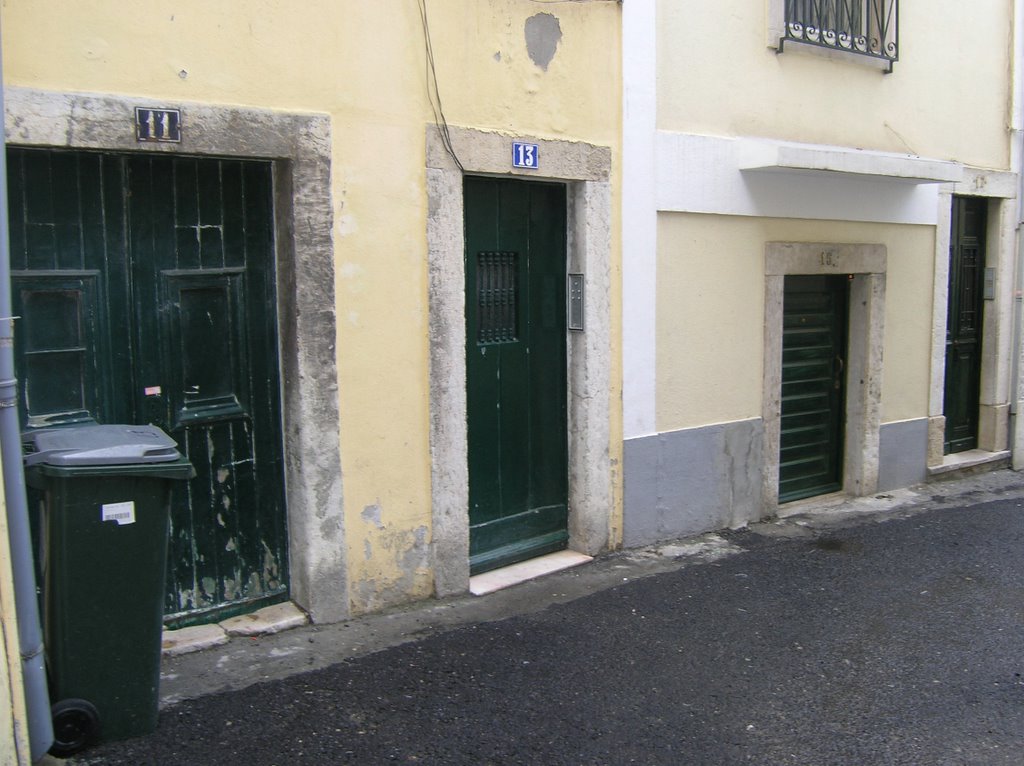
Guess which door is Seoirse's


Having appeared, Seoirse keeps one company while one performs one’s menial tasks. He’s fascinated by practical matters. Occasionally, he provides an extra set of hands. Or he tells stories, or reads Sheamus Heaney, the Nobel Prize winning poet who used to date his sister:

A rowan like a lipsticked girl.
Between the by-road and the main road
Alder trees at a wet and dripping distance
Stand off among the rushes.

There are the mud-flowers of dialect
And the immortelles of perfect pitch
And that moment when the bird sings very close
To the music of what happens.

Seoirse has lived all over Europe, so he has lots of stories to tell. But leprechauns must hide themselves because they cannot hide their feelings. They’re completely vulnerable when caught in the open. Seoirse alternates between weeping and laughter, chiding himself, when describing the Irish struggle for independence from Britain. He cried, too, when I laughed while talking with Drex on the phone. Laughter was forbidden in his father’s household. Owing in part to that prohibition, there’s tension between Seoirse and his Heavenly Father. As far as Seoirse is concerned, the two have not spoken for years, but he has alluded to being open to renegotiating that silence. Please pray he will.

Monday, February 06, 2006

Please pray for Drex: He's had a fever for six days. He hasn't been in school since last Tuesday and he won't be going today. He's got a knarly cough. His class has a field trip coming up this week that they've all been looking forward to for a long time. Please ask God to make him well.

Sunday, January 15, 2006

No Crystal Stair*

Drex’s life is an interesting blend of abundance and deprivation: as an only child (for all practical purposes) with two parents working from home, he sees a lot of his folks. Often—probably more often than if he shared them with siblings—he gets their attention. He lives in a stimulating urban environment. His is a genuine international education. He has travelled extensively for a person his age. Yet he has been repeatedly deprived of close family relationships and friendships. There exists neither culture nor country where he is not a stranger, a foreigner. The largest open space that is part of his daily life is a narrow cobbled street. Sometimes I envy him, sometimes I’m afraid of being arrested for child abuse. We are completely dependent upon God to make it all OK, and to make us sensitive and responsive to Drex’s needs. Thanks for your ongoing prayers for our parenting.

With respect to that international urban education, results thus far are mostly encouraging. Fifth grade at Fernão Lopes in ’06 seems considerably more violent than I remember fifth grade at Wing Lake Elementary School in ‘72, but Drex, hardly the most aggressive kid crammed into the school’s tiny temporary quarters, seems to bear up with remarkable equanimity. While we walk home together he enthusiastically acts out from whom and under what circumstances he’s received the new marks on his face, sometimes handing me his back pack and insisting I stand still on the sidewalk to get the full effect. Thing is, students are more readily held back here, so it is common to meet children one, two and three years older than most of their classmates. The oldest student in Drex’s class is fourteen. So you’ve got a lot of young adolescents, for whom school has not been a crystal stair, with a lot of negative energy, looking out over the heads of their smaller colleagues like so many heads of wheat ready for harvest. I’ve trained Drex to end altercations by tackling low and driving with his legs but that’s a little nuclear for the school’s confined spaces and often not practical. So Drex ignores my advice and makes friends of his enemies instead. Where does he get that? Please pray for his protection and for his enemies.

He’s doing well enough in class. First semester grades are out and Drex’s GPA was 4.6 on a scale of 5, including the only 5 in his Portuguese Language class. Much of the credit goes to the head teacher, Professor Cláudio, who has transformed Drex’s attitude towards school. Debbie and I met and fell in love with Professor Cláudio last September. He is manly, gentle, radiant, encouraging and engaged with his students. He’s been teaching twenty-two years. Though Portuguese by birth, he grew up in Brazil, where he seems to have caught that country’s contagion for life. He believes the way out of Portugal’s present difficulties is paved with little acts of benevolence on the part of its citizens, especially its younger ones. Drex likes him as much as we do. May God bless him in his ministry.

Thanks for praying for us. May the Lord bless you this week as well.


* from

  • Mother to Son by Langston Hughes


  • Sunday, January 08, 2006

    Feeling God's Pleasure

    I drove from one end of Portugal to the other this week. On Monday I went south in the old Habitat for Humanity truck, Manuel, with a load of furniture for Casa Armona, the little beach cottage soon to join the VisitingPortugal.com line-up. We first became acquainted with southern Portugal, known as the Algarve, last summer when the country was in the throes of its worst drought in decades. As far as I knew, the Algarve was brown. Charming in a sun-baked Mediterranean way, but definitely umber. Imagine my surprise when just south of Lisbon verdant hills dappled with sheep, cows and horses and festooned with great lakes—some white, some gold—of tiny flowers (miniature daisies is what they look like up close) began rolling by the highway. Rather than looking like homeless people, destitute, bedraggled and misplaced, as they did last summer, the little whitewashed houses were the very picture of rural simplicity, sufficiency and grace. One wondered how there can be so much talk of economic crisis in the midst of such idyllic prosperity. I played fado—traditional mournful Portuguese music—on my harmonica as I drove along.

    Having delivered my load of furniture I was free to take Manuel north to Braga at the end of the week, where I left him for good with Luis Ribeiro, the current Habitat construction supervisor and mastermind of our self-financing Habitat houses. Luis has worked out a system whereby we build a house using the labor and donations of ten Global Village work teams, each of which works for two weeks. It’s brilliant, and because lots of volunteers want to come to Portugal, we can fill our calendar with as many teams as we can handle. So you’d think we’d be putting up houses from the Minho to the Mediterranean, wouldn’t you? Well, not quite. We’re like a really cool kite that hasn’t quite caught the wind. In fact, at the moment we’re in danger of crashing. We’re looking at some creative ways to get turned around. Would you please ask God to keep us in the air?

    It had been a long time since I had been in Braga and it was very nice to check in with old friends. I joined my little men’s group for their morning prayer hike, breakfasted at our old house with ex-Habitat construction assistant Alvaro Azevedo and his wife, who are caring for nine foster children there, and chatted with our diminutive eighty-two year old former neighbour Dona Rosa, who had heart surgery in the fall and cried when she spoke of how much she misses us (just as she used to cry when she spoke of how much she misses the Leaf family that lived next door to her before we did). I stopped by As Andorinhas, one of the neighborhoods where Vivarte used to operate, and had a beer with Senhor António, whose deformative joint disease you may have read about here before. His fingers, none of which approaches straight or anything less than twice normal size, were wrapped in plastic—something I’d not seen before—against the weeping of incisions made for their drainage. “You’re a hero,” I told him, awed by his suffering. “You just keep doing what you have to do,” he said, in his patient way, his eyelids and facial muscles drooping in response to pain medication. Please continue to pray for António, that God would heal him completely.

    Looking back now upon my autumn trip to America I can see two or three themes that emerged. One was “feeling God’s pleasure.” It came up in conversations with several men. You may remember the expression from the 1981 Academy Award winning film, Chariots of Fire. The hero, Eric Liddell, uses it in response to his sister when she reminds him that God made him a missionary: “Yes,” he replies, “but He also made me fast, and when I run I feel His pleasure.” Feeling God’s pleasure keeps coming up because it is 1) so nice, and 2) a natural indicator of our gifts and what God would like us to do with them. “Delight yourself in the Lord and He will give you the desires of your heart,” King David of Israel, who ought to know, wrote. Just as there is mutuality, a bonding and a shared pleasure, between parent and child when the child manifests his giftedness—in the arena, on the stage, in the classroom, in conversation—so our relationship with God should be characterized by mutual pleasure and delight. One might even say there is a fulfilment, a bringing about of fullness in relationship, when we exercise our gifts, fulfilling the purpose for which He made us. Think about making God feel fulfilled. Where do you feel His pleasure? In thinking about the question myself, I notice that one of the places I feel God’s pleasure is in trying to create a little window upon the world through writing. I’ve been busy about a lot of things lately and haven’t been writing much, so being at the computer this long, feeling God’s pleasure, has come as a pleasant little shock. Would you mind asking God to get me to listen to my own advice? Is there a way to organize your time so you might feel God’s pleasure more? I pray it would be so.

    Thank you for praying for us. Blessed week.

    Sunday, December 04, 2005

    Homecoming

    Among good campers there’s an unspoken agreement: we’ve traded the comforts of home for the excitement and adventure of the road. We don’t complain about the absence of the familiar comforts. We focus on the adventure. I think it’s a good trade. But it takes energy. One may not realize how much until one collapses into an armchair at home.

    Our fifty-five month camping trip ended this week. Our furniture and belongings, which I shipped from Seattle while I was there in September, arrived in Lisbon after eighty days at sea. I sat in my favorite armchair—inherited from my grandmother; exactly like one that appears in Gone with the Wind—and read the newspaper, for the first time in well over four years. Debbie laid on the couch—actually an upholstered aircraft carrier—and delightedly wiggled her toes, unable to reach anywhere near the far end. Drex is beside himself, getting reacquainted with things of which he has only the vaguest memories. Austin and Vitor brought lasagne Friday evening so Austin could play with her dolls. When they left, Vitor dutifully if bemusedly bundled the little trunk with all the tiny doll things off to the car. I was shocked by how nice it is just to be among our things. I had not realized what good campers we were being.

    As a strategic measure, we put together the living room so we’d have a place to which we may retreat, even though it’s almost impossible to move around the rest of the apartment for all the boxes. As I sat in my Rhet Butler chair and looked around I thought about the story it all tells: I remembered where we bought things and when, how young we used to be, people who gave us things, how long we’ve been married. It made me glad. And thankful.

    Decorating for Christmas this year means not just putting out lights and goodies from Christmases past, but unpacking our lives and arranging them so there’s someplace to hang the decorations. Christmas is a time for homecoming. God started it, by sending us His Son, so we may all go home. Getting our furniture has been a powerful reminder of His faithfulness and of how sweet that homecoming will someday be.

    We pray your Advent Season is blessed and that God reveals to you, too, the magnitude of His love and care for you.

    Sunday, November 13, 2005

    "A Luz dos Justos Brilha Alegremente"

    “The light of the righteousness shines happily.” Proverbs 9:12

    (Jesus is our righteousness.)

    I am not a battery, that I might be recharged, as I have imagined. I have no capacity to store energy. I was mistaken because, like the filament in a light bulb, I may remain warm after the power of God has stopped flowing. That is, after I’ve stopped paying attention to God, after the switch has been shut off.

    So what am I to do, if I have to be directly connected to the Source in order to do any good?

    Pray continually.

    Sounds daunting. But if it is no longer I who live but Christ who lives through me, as Paul contends, if I have the very mind of Christ, as Paul argues elsewhere, then it’s all prayer. It’s all prayer. Every thought, every worry, every idea, every complaint, every lust, every enmity, all of it. Everything that passes through my brain passes too through the mind of the Almighty, Who is always with me, Who’s Spirit is so closely allied with my own it is impossible to distinguish between the two. (I’m just repeating what Jesus said). That’s why Paul could talk about praying continually. It’s all prayer. That’s also why Christians must be so terrifyingly careful about what thoughts they admit into their heads. “I tell you that men will have to give account on the day of judgment for every careless word they have spoken. For by your words you will be acquitted, and by your words you will be condemned,” Jesus said (Matthew 12:36-37). That is, every word spoken before God. That is, everything.

    So don’t let anyone convince you you’ve got to get up early or be on your knees or have your hands folded or your eyes closed to pray. It’s good to be on your knees for the same reason it’s good to sit up straight and pay attention in class. But if you have been born again, you’re praying now.

    If you haven’t been born again, join a little group of people who are seeking after God. It hardly matters what tribe. You’ll find saints and heretics almost everywhere you go, but when people set out together to really find God, they find Him.

    Each day a work of art

    Please pray for Zapman (secret identity: Drex). Though indefatigable in his crusade against crime here at home, he has not been as vigilant fighting uncertainty at school. He’s sometimes reluctant to ask questions. That’s normal enough, but well do I remember the dread attending classes where one has fallen behind. Contrast that with the pleasure of keeping up; humbly, diligently making sure you get explanations you understand. It can make all the difference, not just in school but in life. The temptation to pretend you understand can be intense and can lead to all sorts of misery. But asking questions is risky. Colleagues, classmates, Sometimes even teachers, don’t always respond well. To take the risk a person must have resources upon which they know they may draw. The love of God is such a resource. Please pray that Zapman would have a secure sense of it.

    (Incidentally, Zapman comes by his heroism naturally. A young Lisbonita recently remarked, upon seeing Zapman’s mom, a.k.a., Zapma (secret identity: Debbie) carelessly toss aside a heavy burden, “She’s ripped!”)

    Please pray for Crista da Onda, the ministry to at-risk youth with which we are involved here in Lisbon. The organization faces difficult issues, some of which are endemic to young non-profit organizations, others of which are particular to Crista da Onda. Please pray that God would be glorified and that Crista da Onda would flourish and bear much fruit.

    Please pray Psalm 90:12 for me: “Teach us to number our days aright, that we may present to Thee a heart of wisdom.” I am still in the process of bringing some order to life in Lisbon. Of course, given the nature of life and our work in particular it will always involve a certain amount of disorder, but there are certain things a guy’s gotta get done. One of those is keeping in close communication with people who are praying for you. Life has not yet gotten so easy for me that I can forego the resources made available to me in response to other people’s prayers. What I need is unflinching confidence that God will make of each day a work of art—though its artistic quality may be abstruse—self-contained, yet fitting perfectly into the opulent design that becomes a week, a month, a year and a life. That’s the order I’m after.

    Thank you for praying for us. The Lord bless you this week.